
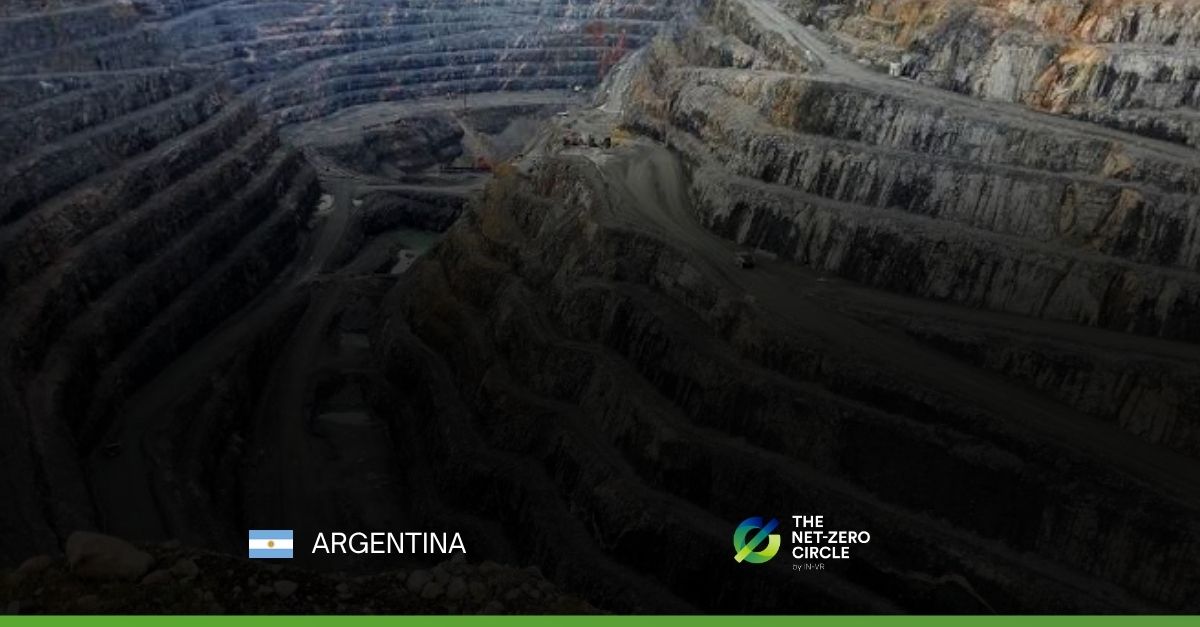
London, UK | 6 October 2026 – The Net Zero Circle| On 2 October 2026, Glencore announced that its Minera Agua Rica-Alumbrera (MARA) copper project in Argentina had received approval under the country’s Incentive Regime for Large Investments, known as RIGI.
The approval marks an important step for one of Argentina’s largest proposed copper developments and gives MARA access to a long-term fiscal, customs and foreign-exchange framework designed to improve investment certainty for major capital projects.
Glencore has previously estimated that development of Agua Rica would require approximately US$4 billion in capital investment, making the RIGI approval particularly significant from a financing and project-economics perspective.
For Argentina’s mining sector, the announcement goes beyond MARA itself. It provides another indication of how the country is using RIGI to reduce long-term investment risk and improve the conditions under which large-scale mining projects can compete for international capital.
Argentina introduced the Régimen de Incentivo para Grandes Inversiones, or RIGI, to create a more predictable framework for major capital investments.
Projects accepted into the regime receive 30 years of stability in tax, customs and foreign-exchange rules, alongside other incentives. Argentina’s tax authority confirms that qualifying entities are subject to a 25% corporate income-tax rate, can access accelerated depreciation and benefit from customs incentives covering eligible capital goods and project inputs.
For a mine requiring several billion dollars of capital and a development timeline measured in decades, those provisions can have a direct impact on project economics.
Mining investors must assess not only the quality of a mineral resource but also whether tax treatment, access to imported equipment, foreign-exchange rules and the ability to operate under predictable regulations will remain sufficiently stable over the life of the investment.
RIGI is designed to reduce that uncertainty.
Glencore Argentina CEO Martín Pérez de Solay said the approval represented an important milestone for MARA and argued that the regime provides the fiscal and regulatory certainty needed to support capital commitments of this scale.
MARA combines the Agua Rica copper-gold deposit with the existing infrastructure of the Alumbrera operation in Argentina’s Catamarca province.
Agua Rica contains estimated measured and indicated resources of approximately 1.2 billion tonnes of ore, with average grades of 0.47% copper, alongside gold, silver and molybdenum. Glencore says the project has the potential to produce an average of more than 200,000 tonnes of copper concentrate annually during its first ten years of operation.
A central feature of the MARA development plan is the proposed reuse of Alumbrera’s existing processing infrastructure, located approximately 35 kilometres from the Agua Rica pit.
That existing infrastructure has economic significance.
Reusing processing facilities and associated logistics can reduce the need to build an entirely new mining complex from the ground up, while potentially lowering execution risk and improving capital efficiency.
Glencore is also progressing with the restart of Alumbrera, where first production is now expected in the second half of 2027, earlier than its previous guidance of the first half of 2028.
The company says the restart is intended to maintain critical infrastructure, retrain and retain workers, and reduce ramp-up risk for both the concentrator and downstream logistics ahead of MARA.
The operation is currently providing work for close to 2,000 people, with most of the workforce coming from Catamarca.
MARA’s approval also illustrates the growing role of RIGI in Argentina’s broader mining investment strategy.
According to Argentine industry publication Minería & Desarrollo, MARA became the 13th mining project admitted to the RIGI framework, taking the reported investment associated with approved mining projects to approximately US$25.23 billion.
That figure should not be interpreted as capital already spent or as equivalent to final investment decisions across every project. It represents reported investment associated with projects admitted to the regime.
Even with that distinction, the scale is notable.
Mining projects typically compete internationally for capital. Developers and shareholders compare potential returns across jurisdictions, taking into account geological quality, infrastructure, political risk, taxation, foreign-exchange restrictions and permitting timelines.
By offering a 30-year stability framework, Argentina is attempting to make those calculations more competitive for projects requiring billions of dollars in upfront investment.
The significance of MARA therefore lies partly in what it represents for the wider sector: a large international miner is moving one of Argentina’s major undeveloped copper assets further into a framework designed specifically to improve long-term investment confidence.
Glencore has described Argentina as a key part of its future copper growth strategy.
Alongside MARA, the company is advancing the El Pachón project in San Juan, for which it previously estimated around US$9.5 billion in capital investment for the first phase. Glencore submitted RIGI applications for both Agua Rica and El Pachón in August 2025.
Together, the developments highlight the scale of Argentina’s potential copper pipeline.
Copper is becoming increasingly important to global energy and infrastructure investment because of its use across transmission networks, renewable generation, electric vehicles, industrial equipment and data infrastructure.
For Argentina, developing large copper deposits could therefore create benefits extending beyond mine production itself, including export revenues, regional infrastructure, skilled employment and opportunities for domestic suppliers.
RIGI approval significantly strengthens MARA’s investment framework, but it should not be confused with a final decision to immediately deploy the full US$4 billion.
Large mining projects still need to advance through technical, environmental, permitting, financing and development stages before reaching full construction.
The economic importance of this approval lies instead in removing part of the uncertainty surrounding those future decisions.
For investors, that can improve visibility over future cash flows and project costs. For Glencore, it provides a more stable framework in which to evaluate the next stages of MARA. And for Argentina, it provides another indication that RIGI is becoming a central instrument in the country’s effort to attract large-scale mining capital.
The wider test will be whether approvals such as MARA ultimately translate into final investment decisions, construction, production and exports.
If they do, the implications will extend beyond Catamarca.
MARA could become part of a broader shift in which Argentina moves from being recognised primarily for its geological potential to becoming a major destination for long-term copper investment.


