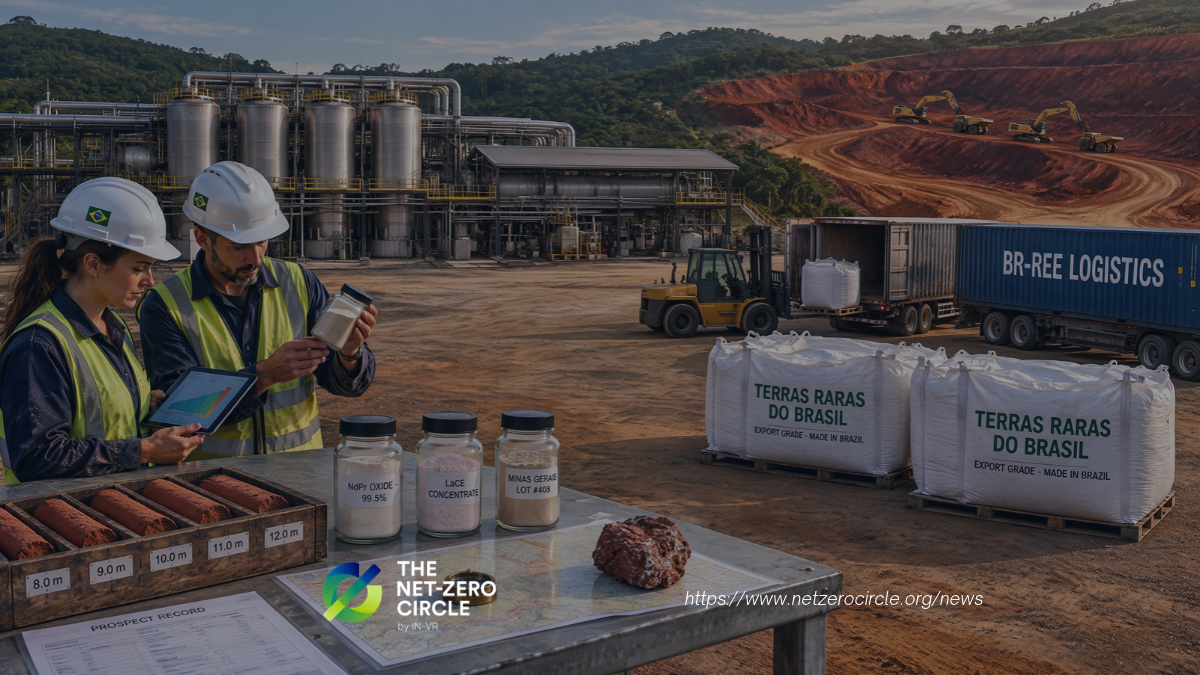
Together, these developments show a country that holds the world's second-largest rare earth reserves starting to turn that geology into production, processing capacity and long-term supply agreements.
USA Rare Earth, which acquired Serra Verde earlier this year, has started shipping mixed rare earth carbonate (MREC) from the Pela Ema operation to US SIIE LLC, a special purpose vehicle funded by the US Department of Defense. Commercial-scale shipments began in October, with the first sales scheduled for November.
The material is sold under a 15-year, 100% take-or-pay offtake agreement with floor prices for the key magnet elements: US110/kgforneodymiumandpraseodymiumandUS575/kg for dysprosium. Pela Ema is an ionic clay deposit and one of the few scaled sources outside Asia of the heavy rare earths used in high-performance permanent magnets.
The operation is also growing. The first stage of an optimisation and expansion programme has been commissioned, production is ramping up to an initial run rate of 4,000 tonnes a year of total rare earth oxides (TREO) by the second quarter of 2027, with a target of 6,400 tonnes a year by the end of 2027. A second phase that could double output is under evaluation.
At the start of October, Lynas Rare Earths, the largest producer of separated rare earths outside China, agreed to acquire Meteoric Resources and its Caldeira ionic clay project in southern Minas Gerais in an all-share deal valued at about A968million(US672 million). Meteoric's board has recommended the scheme, with a shareholder vote expected in late January 2027 and completion targeted for early March 2027, subject to shareholder, court and regulatory approvals.
Caldeira is one of the largest known ionic clay rare earth resources outside China. Its feasibility study outlines output of around 12,500 tonnes of TREO a year over a 23-year mine life, with initial capital expenditure of just under US$500 million, excluding separation.
The next question is where that material will be processed. Lynas is studying a rare earth oxide separation plant in the Poços de Caldas region, and Brazil's development bank BNDES is assessing possible project finance, with a technical visit to Lynas' Australian operations planned before the end of 2026. Officials see Poços de Caldas as a potential regional hub that could also take feed from other deposits in southern Minas Gerais. Lynas has kept its guidance cautious and retains the option of processing Caldeira material through its existing plants in Australia and Malaysia.
The producers are not alone. Recent weeks have brought a steady flow of news from earlier-stage projects:
Rare earths are now at the centre of Brazil's critical minerals strategy, and the focus is shifting from mining alone to separation, refining and long-term supply contracts. Long-dated offtakes with price floors, the involvement of development finance and the arrival of an established global producer all point to a sector that is becoming investable at scale.
For Minas Gerais in particular, the prospect of a separation hub in Poços de Caldas would add a new rare earths chapter to a state already known for lithium, niobium and iron ore. The key milestones to watch over the coming months are the Lynas–Meteoric vote and completion, BNDES' decision on the separation plant, and the pace of Serra Verde's ramp-up.
These are among the topics that will shape the discussions at the 4th Brazil Lithium & Critical Minerals Summit, taking place from 8 to 10 June 2027 in Belo Horizonte, where producers, developers, investors, technology providers and government will come together to discuss Brazil's role in global critical minerals supply chains.