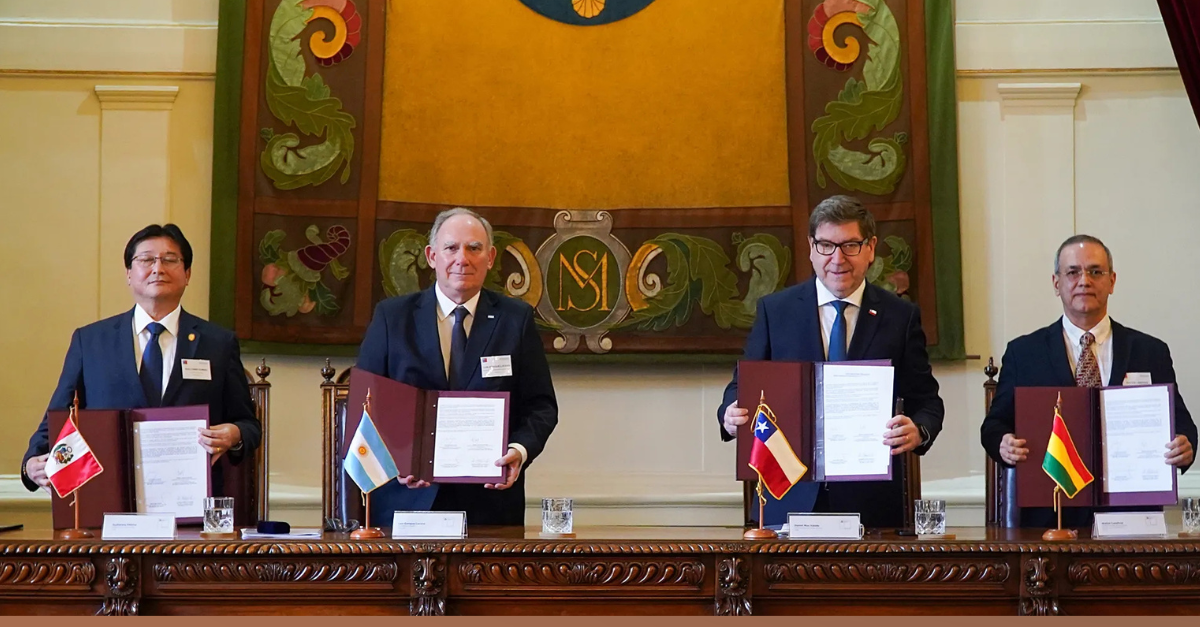
Chile, Argentina, Bolivia and Peru signed a joint declaration on strategic minerals in Santiago on Friday, 28 August, establishing a framework for cooperation on mining policy, supply chains, technical capabilities and responsible investment. The agreement was signed during the first Ministerial Meeting on Strategic Minerals and Regional Integration at the Salón de Honor of the Municipality of Santiago, according to Peru’s Ministry of Energy and Mines.
The declaration is intended to improve coordination among four countries with important mineral resources, while preserving each government’s sovereignty over its natural assets. Its scope includes information-sharing, regulatory and environmental practices, geological cooperation, mine closure, innovation, workforce development and investment across the mining value chain.
It is not, however, a binding treaty, supranational regulator or project-financing agreement. The official announcement does not establish common production targets, a unified permitting system, specific mine developments or committed funding. Its significance will therefore depend on whether the governments convert broad political commitments into practical cooperation.
The Santiago meeting brought together Peru’s Energy and Mines Minister Guillermo Shinno and the mining ministers of Chile, Argentina and Bolivia. Peru’s ministry said the declaration seeks to position the participants as strategic and reliable partners in the responsible development of critical minerals and to support supply chains that are secure, resilient and sustainable.
The participating governments agreed to exchange information and experience, including on mining regulation and the management of environmental and social issues. They also expressed support for convergent approaches in international forums, where appropriate, to improve market access and strengthen the region’s ability to engage with consuming countries.
The declaration signals political alignment, but it does not automatically change domestic laws or guarantee identical standards. Chile, Argentina, Bolivia and Peru retain separate legal systems, permitting processes, fiscal regimes and approaches to resource development. Companies will therefore still need to comply with the laws and procedures of the jurisdiction where each project is located.
The agreement’s agenda reaches beyond the production of mineral concentrates. It identifies cooperation in geology, environmental management, oversight, public policy, mine closure, innovation and specialised human-capital formation. It also refers to promoting responsible investment and economic development along the mining value chain.
The priorities are relevant to efforts to capture more value from natural resources through processing, technical services, equipment supply, research and workforce development. The declaration does not confirm specific processing plants, refining projects or downstream investment commitments. Any value-add strategy will require capital, infrastructure, energy and water, technical expertise, market demand and regulatory approvals.
Peru’s ministry reported that the meeting included a second session titled “Capacities that connect the region: institutions, suppliers and talent.” Working groups were formed in the areas of suppliers, human capital and institutional capacity. These groups could provide an initial channel for turning the declaration’s general objectives into more defined programmes, although the official release does not identify a permanent secretariat, implementation timetable or list of priority projects.
For the mining industry, the immediate impact of the agreement is likely to be institutional rather than operational. The governments have identified areas where cooperation could improve the investment environment, but the declaration itself does not finance exploration, shorten permitting timelines, remove political risk or create offtake contracts.
Projects will continue to face the usual development tests. These include geological and technical validation, environmental and social assessments, land and water considerations, community engagement, infrastructure availability, fiscal conditions and access to capital. The declaration may support a more coordinated policy conversation, but it cannot substitute for project-level due diligence.
A resilient regional chain also requires transport links, ports, power systems, processing facilities, skilled labour, transparent regulation and buyers willing to sign commercial agreements.
Minister Shinno said the declaration would allow Peru to position itself as a reliable partner to consuming countries while defending its sovereignty over natural resources. That statement describes Peru’s policy interpretation of the agreement. It should not be read as evidence that the declaration guarantees market access or secures future investment.
The four governments have not publicly detailed how the declaration will be administered or measured. Questions include whether they will create a formal coordination body, how technical information will be shared and how progress will be reported. Companies and investors will also need clarity on how any regional guidance interacts with domestic law, permitting and consultation obligations. The declaration does not create a single mineral market or common fiscal regime.
The next milestone should be the development of concrete work plans following the Santiago meeting. Investors and project developers will be watching for technical committees, timelines, priority areas, information-sharing mechanisms and evidence of cooperation in geological, environmental, institutional and workforce programmes.
A second test will be whether the governments can connect policy coordination with investable projects. That will require measurable progress at the project level: permits obtained, studies completed, infrastructure advanced, financing committed and commercial partners identified. Until those steps occur, the declaration should be treated as a strategic policy signal rather than a change in the operating status of any mine.
The development is directly relevant to The Andean Bridge’s stated role. The platform describes itself as a year-round structure connecting mining and critical-minerals projects across Argentina, Chile, Peru and Bolivia with global capital. Its website identifies medium-sized and smaller miners moving from development toward institutional readiness as a core focus, supported by training, capital forums and an Andean Mining Accelerator.
That model addresses a different part of the market than the ministerial declaration. Governments can coordinate policy and institutions, while a private-sector platform can prepare projects, improve visibility and connect developers with potential investors and technical partners. The declaration’s emphasis on institutional capacity, responsible investment and value creation is therefore relevant to Andean Bridge’s operating environment.
The relationship should nevertheless be stated carefully. The official Peruvian announcement does not identify Andean Bridge as a signatory, government partner, financier or beneficiary of the declaration. The agreement does not formally endorse the platform, and it does not guarantee that projects presented through it will receive approvals or financing.
The longer-term connection is therefore strategic rather than formal. If the four governments follow through with practical cooperation, Andean Bridge could operate within a clearer regional policy narrative when preparing projects for international capital. But the platform’s value, like the declaration’s impact, will ultimately be tested by execution: whether coordination becomes concrete institutional support and whether that support helps turn credible Andean mineral projects into financeable opportunities.